
Warline: Sniper Strike
Powerfantasy HK LimitedStrategy
4.91.20K Reviews
- Version
- 1.3.01
- Installs
- 5.00M
- Age Rating
- Teen
Screenshots
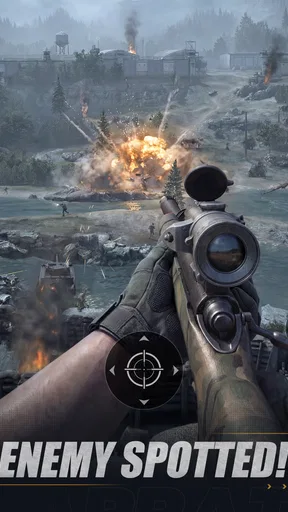
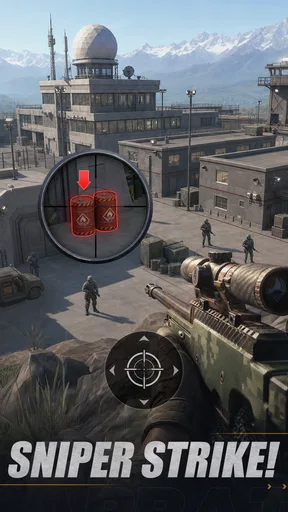
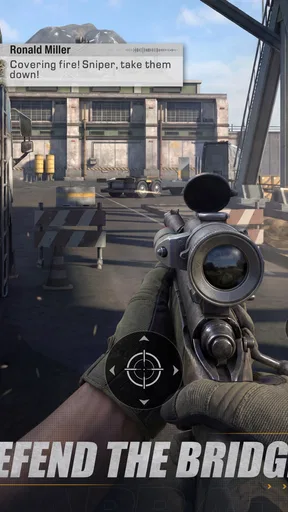
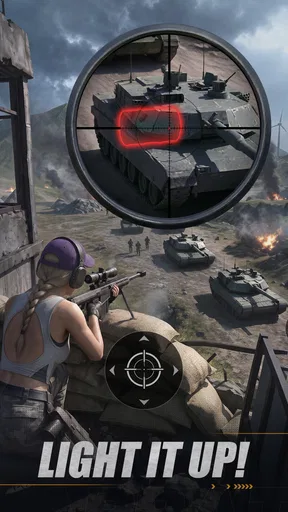
Our Review of Warline: Sniper Strike
 Analysis by Appyee
Warline: Sniper Strike is a strategy game built around the tension between a carefully chosen shot and the larger consequences of a battlefield decision. I found it most interesting when I stopped treating each encounter like a quick shooting challenge and started thinking several moves ahead. Its central appeal is the meeting point between tactical shooting and real-time strategy, although the balance between those two sides will matter a lot depending on what you expect from a mobile war game.
Developed by Powerfantasy HK Limited, the game is free to start and aimed at a Teen audience. It has reached over a million installs and holds a 4.9 average from around 116 thousand ratings, which gives it a strong first impression among players. The current version is 1.2.01, and it runs on Android 6.0 or later. Those details make it accessible to a wide range of Android phones, but the free entry point should not be confused with a completely cost-free experience: optional purchases range from $0.99 to $199.99 per item.
Where every shot becomes a strategic decision
The easiest way to misunderstand this game is to focus only on the word “sniper.” Precision matters, but the satisfying part is deciding when precision is worth using. A shot can solve an immediate problem while creating another one, and the strongest decisions usually come from judging the whole situation rather than chasing the most obvious target.
I like that this framing gives the game more personality than a conventional mobile shooter. In a standard action game, the answer is often to react faster and aim more accurately. Here, I found myself asking different questions: should I remove the most dangerous opponent now, preserve an opportunity for later, or accept a smaller gain to keep the situation under control? That change in mindset is what makes the strategy layer meaningful.
The real-time element adds pressure because planning cannot continue forever. You have to make decisions while the situation develops, which creates a useful trade-off between careful thought and timely action. Waiting may produce a better plan, but waiting too long can make the plan irrelevant. Acting immediately can protect you from a developing threat, yet it may also waste an advantage that would have been more valuable a moment later.
For me, this creates a better fit for short, focused sessions than for casual background play. I can pick it up when I have enough attention to follow a situation, but it is not the kind of game I would recommend while distracted by messages or a television show. The tactical layer rewards awareness, and losing that awareness makes the experience feel less deliberate.
Planning beyond the obvious target
One useful habit is to separate the target that looks most dangerous from the target that is actually limiting your options. The strongest-looking enemy is not always the one that deserves immediate attention. Sometimes the better decision is to deal with the opponent that blocks movement, threatens a future position, or makes your next response predictable.
This is one of the game’s less obvious strengths. It encourages me to think in terms of future choices rather than only current damage. A successful turn is not necessarily the one that creates the biggest visible result. It may be the one that leaves me with more safe responses when the battlefield changes.
I also found it helpful to establish a simple priority order before acting: immediate danger first, then the opponent that restricts future options, then the target that offers the best reward. This is not a rigid formula, because the right order changes with the situation, but it prevents hurried decisions. In a game that combines shooting with strategic timing, a few seconds of structure can be more useful than frantic precision.
That approach also explains who will enjoy Warline: Sniper Strike most. Players who like tactical puzzles, controlled aggression, and planning under pressure should find plenty to appreciate. Players looking for a purely relaxed shooting experience may find the strategic responsibility slows down the fun. Likewise, anyone who prefers a deep traditional strategy game with long uninterrupted planning phases may find the real-time pressure less comfortable.
Risk, reward, and the cost of impatience
The game’s risk-and-reward appeal comes from committing to a decision before you know exactly how the situation will unfold. A cautious choice can preserve control, but it may surrender momentum. An aggressive choice can create a decisive opening, but it can also expose the weakness you were trying to hide.
I think this is where the title earns its tactical identity. The value of a shot is not only whether it succeeds. It is also what the shot reveals, what it forces the opponent to do, and whether it leaves you prepared for the response. A player who evaluates only the immediate result will sometimes win the exchange but lose the larger position.
One practical technique is to avoid spending your best opportunity simply because it is available. When the battlefield is stable, I prefer to ask what would make the next decision easier. If the answer is “removing a threat now,” I act. If the answer is “keeping the threat under observation while improving my position,” patience is usually better. This makes the game feel less like a sequence of isolated attempts and more like a chain of commitments.
There is a downside to this design. When a mistake follows from several connected decisions, the result can feel harsher than in a straightforward shooter. A player may know how to aim but still lose because the earlier plan was too narrow. That can be rewarding once the lesson becomes clear, but frustrating when the game does not make the cause of failure easy to understand.
The free-to-play structure is another trade-off worth considering. The game costs nothing to begin, which makes experimenting easy, but optional purchases can reach a very high price for a single item. I would approach those purchases carefully and decide in advance whether I am comfortable spending at all. Players who want a completely uniform experience without monetization pressure should think about that before committing time.
Adapting instead of repeating the same plan
The most valuable form of adaptation is not simply changing targets. It is changing the reason behind your next action. If an aggressive opening repeatedly leaves you exposed, the answer may not be a different shot; it may be a slower opening that protects your later choices. If a cautious approach allows the opposition to build too much pressure, you may need to accept an earlier risk instead of waiting for perfect certainty.
I found that reviewing a failed attempt through three questions is more useful than blaming aim. What did I assume would remain true? Which threat did I underestimate? At what point did I lose the ability to respond? Those questions turn a defeat into a planning lesson and help distinguish a mechanical mistake from a strategic one.
This is also where the game compares favorably with ordinary mobile shooters. Traditional shooters often reward repetition until a player memorizes routes or improves reflexes. Warline: Sniper Strike still benefits from accuracy, but repeating the same behavior is less reliable when the strategic context changes. The better player is not always the one who attacks fastest; it can be the one who recognizes that yesterday’s successful pattern is now a liability.
Compared with large-scale real-time strategy games, however, the experience is more immediate and more focused. You are not managing every broad layer of a sprawling campaign. That makes it easier to understand in short sessions, but it also means players seeking extensive economic management, enormous maps, or a long-form empire-building structure may prefer a conventional RTS instead.
Another comparison is with turn-based tactics. Turn-based games give you time to inspect a position and calculate without a clock pressing every decision. Warline: Sniper Strike offers a more nervous rhythm because the battlefield keeps moving. I prefer this when I want tension and quick adaptation, but turn-based alternatives are better when I want to study a position with complete calm.
How the depth develops over time
The game’s long-term value depends on whether you enjoy improving your decision process, not merely unlocking the next piece of content. I became more interested once I started noticing patterns in my own mistakes. Early on, it is tempting to judge progress by successful shots. Later, I found more satisfaction in reaching a point where I could identify danger before it became urgent.
That kind of depth is personal rather than purely numerical. A player who enjoys mastering a system through observation will likely get more from it than someone who needs constant novelty. The game works best when each session gives you a reason to adjust your approach, whether that means changing the order of priorities, accepting a calculated risk, or preserving an option that would previously have been wasted.
A useful everyday scenario is a short evening session after work. I would not begin by trying to rush through several encounters while tired. Instead, I would play one focused attempt, notice the decision that caused trouble, and use the next attempt to test one adjustment. That workflow makes the game feel manageable and turns limited playtime into deliberate practice rather than a string of rushed losses.
It is also worth considering the device requirement. Support for Android 6.0 or later means the game is not restricted to only the newest phones, which is helpful for players using older hardware. Still, strategy games with active visual scenes can feel different depending on screen size, touch accuracy, and general device performance. I would test the controls during the first session before deciding whether the game suits a particular phone or tablet.
The Teen content rating is another practical point for families. It signals that this is not aimed at young children, so parents should consider whether its military theme and shooting focus fit the intended player. For older teens and adults who enjoy tactical conflict without needing a fully traditional war simulation, the tone is likely to be more appropriate.
Who should play it, and who should pass
I would recommend Warline: Sniper Strike to someone who likes the idea of combining accurate shooting with planning under pressure. It is especially suitable for players who enjoy asking why a move worked, not just whether it worked. The game can also appeal to fans of compact strategy sessions who want more decision-making than a reflex-only shooter provides.
I would be more cautious recommending it to someone who wants a simple, instantly relaxing game. The need to monitor consequences can make even a short session mentally active. It is also not the best choice for players who dislike free-to-play economies or who feel uncomfortable when optional purchases are presented alongside progression. The wide purchase range makes spending discipline important.
Players who want a full-scale RTS should also set expectations correctly. The store summary presents a tactical shooter and RTS blend, but I would approach it as a focused hybrid rather than a replacement for a large desktop-style strategy game. Its appeal is the compressed decision space: meaningful choices arrive quickly, and the player must connect a precise action with a broader plan.
For newcomers, my advice is to resist the urge to measure success only by speed. Spend the opening moments identifying what can immediately punish you and what can wait. Then choose one objective for the encounter. Trying to solve every problem at once usually produces a messy plan, while a clear priority gives you a way to judge whether the next action is helping.
For experienced strategy players, the challenge is to avoid overplanning. The real-time structure punishes endless calculation, and a theoretically perfect idea is worthless if it arrives too late. I found the best rhythm somewhere between preparation and commitment: form a short plan, act, watch the response, and revise before the situation closes around you.
My verdict on the tactical trade-offs
Warline: Sniper Strike succeeds when it makes a shot feel like part of a plan rather than an isolated tap. Its strongest moments come from weighing immediate safety against future control, deciding whether a reward is worth the exposure, and adapting when the first idea stops working. That gives it more strategic character than the average mobile shooter.
It is not frictionless. The real-time pressure can make mistakes feel severe, the hybrid format may not satisfy players seeking either a pure shooter or a full RTS, and the optional purchase structure deserves careful attention. Those limitations are not minor details; they directly affect whether the game fits your habits and expectations.
Even so, I think the free starting point makes it easy to discover whether its decision-making style works for you. Powerfantasy HK Limited has built a game for players who enjoy controlled risk, tactical observation, and learning from a failed plan. If you want every action to carry a consequence beyond the immediate target, this is a strategy game worth trying. I would recommend it to thoughtful mobile players, while steering purely casual shooters and traditional RTS enthusiasts toward alternatives that match their preferred pace more closely.
My final advice is simple: play it with enough attention to notice why a decision succeeded or failed, keep spending optional rather than automatic, and judge the game by the quality of its choices rather than by the speed of its action. That is where Warline: Sniper Strike has its clearest identity, and it is also the reason I would return to it when I want a compact tactical challenge instead of another routine shooter.
Privacy and Permissions
See what permissions an app requests and how it handles your data.
- Device & app history
- retrieve running apps
- Calendar
- read calendar events plus confidential information, add or modify calendar events and send email to guests without owners' knowledge
- Location
- approximate location (network-based), precise location (GPS and network-based)
- Phone
- read phone status and identity
- Photos/Media/Files
- read the contents of your USB storage, modify or delete the contents of your USB storage
- Storage
- read the contents of your USB storage, modify or delete the contents of your USB storage
- Camera
- take pictures and videos
- Microphone
- record audio
- Wi-Fi connection information
- view Wi-Fi connections
- Device ID & call information
- read phone status and identity
- Other
- view network connections, pair with Bluetooth devices, send sticky broadcast, change network connectivity, connect and disconnect from Wi-Fi, full network access, change your audio settings, run at startup, reorder running apps, control vibration, prevent device from sleeping, Google Play license check
Verdict
Strengths of Warline: Sniper Strike
- Responsive sniper controls make aiming feel precise and satisfying.
- Short missions are convenient for quick gaming sessions.
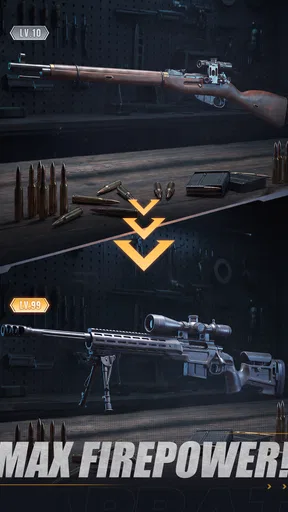
- Weapon upgrades provide a clear sense of progression.
- Enemy encounters offer varied distances and shooting angles.
- The military setting gives the game a focused, action-oriented atmosphere.
Limitations of Warline: Sniper Strike
- Some upgrades may require considerable grinding to unlock.
- Repeated mission objectives can make later stages feel predictable.
- Small targets are difficult to see on phones with compact screens.
- The shooting pace may feel slow for players seeking constant action.
- Performance can vary on older devices during visually busy scenes.
Similar Picks in This Category
View All
Clash of Clans
Supercell4.5

Plants vs. Zombies™
ELECTRONIC ARTS3.7

Lords Mobile: Kingdom Wars
IGG.COM4.5

Clash Royale
Supercell4.4

State.io — Conquer the World
CASUAL AZUR GAMES4.1

Car Driving School : Car Games
Spark Game Studios3.9
Frequently Asked Questions
What is Warline: Sniper Strike, and how does the gameplay work?
Warline: Sniper Strike is a mobile shooting game centered on sniper missions and tactical combat. You typically observe the battlefield, identify targets, adjust your aim, and fire at the right moment. Missions are generally designed around accuracy, timing, and eliminating enemies efficiently rather than simply shooting continuously. The game may also include progression systems, different weapons, upgrades, and increasingly difficult stages.
Can Warline: Sniper Strike be played offline?
Whether Warline: Sniper Strike works fully offline can depend on the specific version, device, and feature being used. Some campaign missions may be available without a constant connection, while advertisements, cloud synchronization, rewards, updates, or other online services may require internet access. Before downloading, users should check the current store description and test the game in airplane mode, especially if they expect to play during travel or with limited mobile data.
Is Warline: Sniper Strike free to download, and does it include in-app purchases?
Warline: Sniper Strike can generally be downloaded without an upfront purchase, but free access does not necessarily mean that every feature is completely free. Mobile games of this type may use optional in-app purchases for currency, weapon improvements, extra resources, or faster progression. Advertisements may also appear between missions or when claiming bonuses. It is worth reviewing the store listing and enabling parental controls if children will use the device.
What devices are compatible with Warline: Sniper Strike?
Compatibility depends on the operating system version, hardware performance, available storage, and the requirements set by the developer. Recent Android and iOS devices should provide the best experience, while older phones may experience longer loading times, reduced visual quality, or occasional performance issues. Before installing, check the official Google Play or App Store page for the required operating-system version and make sure sufficient free storage is available for the game and future updates.
Does Warline: Sniper Strike require an account or contain advertisements?
The game may allow players to begin without creating a separate account, although an account or platform connection can be useful for saving progress, restoring purchases, or synchronizing data between devices. Advertisements may also be included as part of the free-to-play model, particularly after missions or when choosing optional rewards. The exact frequency can change with updates, so users should review the latest store information and the game’s privacy and data-safety details before installing.
Play our best games!


